Saturday, January 2, 2016

Okinawa Day 7: The Former Japanese Naval Underground Headquarters

Wednesday, May 6th--We had a really good night sleep last night!  We didn't sleep that great while we were staying in Kiyoko san's home.  Maybe it was because the house was really dirty (she didn't have very many cleaners so I couldn't really clean it up much) and Raymond's and my bed was an uncomfortable hide-a-bed pulled out of an old couch.  Whatever it was, it was refreshing to wake up rested and open the curtains to a beautiful, sunny morning! 
We had a late start this morning because we had to figure out how we were going to get around today.  Transportation has been an issue during our entire stay on this island.  We had a bus stop near our apartment, but that bus route didn't go by any of our planned stops for the day.  We would have had to switch buses several times and riding the bus on this island is so ridiculously expensive!  Finally, Raymond called a taxi and we all piled in--several of us sitting on laps--and headed to our first destination for the day.  We were all super excited to tour the Former Japanese Underground Naval Headquarters!  We had been waiting all week for this! 
When we arrived, we arranged for the taxi driver to come and pick us back up in a few hours.  While Raymond was talking to him in Japanese about it, the rest of us noticed a hedge with hibiscus flowers growing on it.  All of my life, I've wanted to see a hibiscus flower in real life.  They are simply stunning and the pictures don't do them justice. 
The entrance to the Underground Headquarters Museum.  
Right after we walked in, we decided to have everyone go to the bathroom before we went down into the tunnel.  Near the bathrooms was this work of art.  It is Shuri Castle made out of strung origami cranes.
This is a map of the underground tunnels.  They have a little over half of it cleaned out, but there are still parts of it that are not available to tour.
The first part of the tour is a little one room museum and reviews the war, focusing on the Battle of Okinawa.  There are also several items on display that were found in the tunnel after the war.  This Japanese flag is one of the things that was found down in the headquarters.
There were also some household items on display, such as a teapot, a rice bowl, glass medicine bottles, a compass, etc.
This is Rear Admiral Ota's personal things and some of his uniform.  He was the commanding officer at the Naval Underground Headquarters.  I like his fan. 
Guns and spears found in the tunnel.
The description next to the displayed guns reads: 
"The Battle Around the Underground Tunnel
Having destroyed all artillery and machine guns before moving to the Kyan Peninsula, the Navy forces possessed only some minor handmade weaponry in addition to Type-38 rifles* when they returned to their defensive position in Oroku.  These improvised weapons included spears made from train rails used by the Construction Corps and hand grenades and other explosive devices that were made with gunpowder taken from 250 kg high-explosive bombs and were used in the type of attack called "Nikudan", or human bullet.  The Nikudan charges against M3 tanks presumably had an effect in halting the advance of the U.S. for 10 days. 
*Type-38 rifle: Standard rifle of the Japanese military, adopted in 1905 (38th year of the Meiji era), possessing great accuracy and widely used in the Battle of Okinawa."

These were pictures of the officers and their families.  There were also some personal letters written to their families before they committed seppuku.   
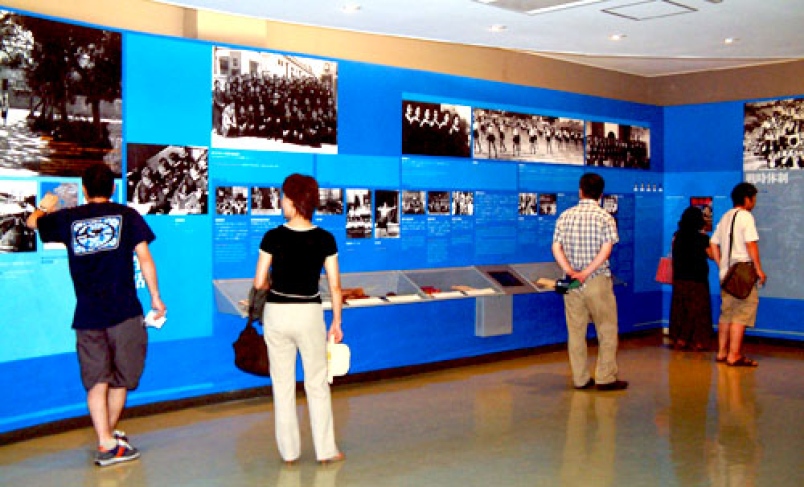
There was a timeline of the Battle of Okinawa that was very detailed and well done. 
It had a lot of pictures of the war and of the people involved. 
A picture of the day that the U.S. landed on the shores of Okinawa.
I was surprised that the kids were so engrossed in the timeline.  We had learned about the Battle of Okinawa all day yesterday, and I would have thought that they would have been tired of it.  But, the timeline was so detailed that it reviewed everything we learned yesterday and also added more detail into the events of this horrible three month battle.  We all read every bit of the timeline.
In this timeline, we found this picture of some Japanese soldiers holding a Japanese flag exactly like the flag that was found in the Naval Headquarters after the war.
 Yeah.  It's hard to imagine such destruction and death.
This described what happened at the Underground Headquarters and how the fall of these tunnels helped to mark the end of the battle on this island.
Some of the people who committed seppuku in the Navy Underground Headquarters along with Rear Admiral Ota on June 13, 1945.
Some of Captain Hitoshi Tanamachi's  (who is pictured above) uniform that was retrieved from the tunnel after the war.  Notice the cherry blossoms that attaches to the neck of uniform.  The ancient samurai thought that after they died, they would come back as cherry blossoms.  It is fitting that cherry blossoms were on the military uniform of the Japanese empire.
Nathan wanted a picture of him with this picture of a little Okinawan boy naked and standing up to his knees in mud.  He said that he wanted a picture with it so that he never forgot what the Okinawans went through.
During the battle, many Okinawans would run to the cemeteries and hide in the stone vaults that held the ashes of whoever was interred there.  This is a picture of two children hiding in a vault and were found by the U.S. soldiers.
I thought that this was poignant.
The raw numbers of the Battle of Okinawa and dates relating to the recovery of the Naval Headquarters.
The Okinawan people were told by the Japanese war propaganda that if the U.S. soldiers "captured" them, they would be tortured, raped, and killed in unimaginable ways.  I read somewhere yesterday that the island's children were told that if an American soldier found them, he would pick them up by their ankles and rip them in two from their crotch.  This is why so many, many Okinawans killed their own children in panic before killing themselves as the Americans landed.  They truly feared what the American soldiers would do to them. 
All day yesterday, I looked for a place that taught what the U.S. forces did for the Okinawans when they landed.  It was a time of war and they had to do their job, but their fight was not with the Okinawans--it was with the Japanese.  The U.S. brought in supplies, medicine and food for the islanders.  They did whatever they could to help them find their family members and rebuild their homes.  I finally found where they taught about this here at the Naval Headquarters.
Another section told the personal story of a survivor.  He and his friends had taken a grenade from the Japanese toward the end of the battle. They took it out somewhere secluded then sat in a circle and pulled the pin. There was a huge explosion, and when the man woke up, all his friends were dead while he sat injured but very much alive. When the Americans came, he was too injured to run, and so he was captured. As they nursed him back to health, he realized that his friends had died in vain.
 
Unfortunately, the American military is not innocent when it comes to dealing with the people of Okinawa.  Farms and homes were confiscated as the military moved in and built the many bases that dot this island. 
 
This is a picture of Rear Admiral Ota.  He was in charge at the Underground Naval Headquarters.  He wrote a powerful telegram to his Vice Admiral in Tokyo.  His telegram is seen as an important part of history because it is the one time where a Japanese officer recognizes and honors the work and sacrifice of the Okinawans during the battle.  The entire telegram is as follows:
Sent at 20:16 on the 6th of June, 1945:
"Please convey the following telegram to the Vice-Admiral.
While the Governor should be the person to relay this report on the present condition of the Okinawa prefectural inhabitants, he has no available means of communication and the 32nd Division Headquarters appears to be thoroughly occupied with their own correspondences. However, due to the critical situations we are in, I feel compelled to make this urgent report though it is without the Governor's consent.
Since the enemy attack began, our Army and Navy has been fighting defensive battles and have not been able to tend to the people of the Prefecture. Consequently, due to our negligence, these innocent people have lost their homes and property to enemy assault. Every man has been conscripted to partake in the defense, while women, children and elders are forced into hiding in the small underground shelters which are not tactically important or are exposed to shelling, air raids or the harsh elements of nature. Moreover, girls have devoted themselves to nursing and cooking for the soldiers and have gone as far as to volunteer in carrying ammunition, or join in attacking the enemy.
This leaves the village people vulnerable to enemy attacks where they will surely be killed. In desperation, some parents have asked the military to protect their daughters against rape by the enemy, prepared that they may never see them again.
Nurses, with wounded soldiers, wander aimlessly because the medical team had moved and left them behind. The military has changed its operation, ordering people to move to far residential areas, however, those without means of transportation trudge along on foot in the dark and rain, all the while looking for food to stay alive.

Ever since our Army and Navy occupied Okinawa, the inhabitants of the Prefecture have been forced into military service and hard labor, while sacrificing everything they own as well as the lives of their loved ones. They have served with loyalty. Now we are nearing the end of the battle, but they will go unrecognized, unrewarded. Seeing this, I feel deeply depressed and lament a loss of words for them. Every tree, every plant life is gone.
Even the weeds are burnt. By the end of June, there will be no more food. This is how the Okinawan people have fought the war. And for this reason, I ask that you give the Okinawan people special consideration, this day forward".

With the U.S. forces closing in, after he sent this telegram, he sent another personal telegram to his family before committing seppuku with a handgun.
After spending some time in the small museum, we were ready to head down to into the headquarters themselves.  Here we are at the entrance.  This is where the Japanese naval command gave orders, made their last stand, and finally died by their own hands rather than surrender.
There were many stairs as we climbed down.
The Former Japanese Naval Underground Headquarters is the air-raid shelter used as the headquarters of the Japanese Navy during the Battle of Okinawa in 1945.  It is on a hill located about 4 km south of central Naha city.  The Japanese Navy constructed this underground headquarters to guard the important airport which is the current Naha Airport. The soldiers could overlook the airport on this hill. 
There are conflicting reports as to who exactly built this headquarters.  Some say it was the Japanese military, others say it was Okinawan civilians.  We tend to think it was the Okinawans, based on everything we have learned on this island so far in regards to WWII and the relationship between the Japanese and the Okinawans.
It was already quite hot outside, but as we descended, the air got considerably cooler.  It was so pleasant to get a respite from the heat that has beset us every day.  Both Raymond and Christopher are starting to get heat rash on their backs and arms.  (Chris is also suffering from some type of rash that is blistering his arm.  We are wondering if he got bit by a bug and is having a reaction or if something in the ocean got him.)  The walls were damp with condensation and the air was musty.
This is the Signal Room.
The walls were of sheer rock, and it was very rough.  We could see pick axe marks in the stone.
 
This is the Operations Room.
This is a picture that was displayed on a wall of the Operations Room.  This room was used for operational planning.  Because of its importance, the interior was constructed of concrete and covered with plaster.  The condition of the room has changed little since the battle.
The underground headquarters was completed in December 1944.  The total length of the tunnels are about 450 meters. (Around 300 meters are currently open to the public.)  Planning rooms, staff rooms, soldier rooms and so on were set up.  It is estimated that about 4,000 men were stationed here. 

In another room, there were pock marks in the walls and ceiling from hand grenades that were set off by the Japanese soldiers as a means to commit suicide because the U.S. forces were coming in.

Ota had made an agreement with the commander of the 32nd Army (we saw the entrance to the army's underground headquarters the day that we visited Shuri Castle) that once they retreated south he would destroy the weapons at the naval underground headquarters and follow.  Due to a miscommunication, Ota enacted the plan, but when they arrived in the south, he realized the 32nd Army was not there. He ordered a return to the tunnel complex.  This turn of events made it so that the navy soldiers were in these tunnels without much in the way of weaponry just waiting for the Americans to come.
The Commanding Officer's Room.
There was some writing on one wall, but there wasn't an English translation.  On the opposite wall, there was Ota’s "favorite" poem:  “Born as a man, nothing fulfills my life more than to die in the name of the Emperor.”
The caption for this picture reads:  "Fierce ground fire by the U.S. Army at Yomitan Airfield."
"Bombardment of Naha, the capital of Okinawa."
"Two American soldiers who aim at Japanese snipers in the church at Shuri."
By looking at Caitlin's frame you can see how small and tight these tunnels are.
Beds no longer exist in the sleeping quarters, but chinks in the rock showed the beds had been four-high on both walls, just large enough for a person to lay in lengthwise, and just wide enough for bunks on two sides and a narrow corridor in the middle.
We noticed this carving into the rock.  It's in Japanese, so we don't know what it says.
All passageways were used by the naval personnel as a place to rest and sleep during the battle.
The sign posted here stated that this is the Medical Room.
The black and white picture in the room had a caption that read: "Survivors of the battle remember seeing numerous casualties in this area, so it is likely that this was the tunnel's medical facility."

The Generator Room.
This pick axe was on display to show what tools were used to build the tunnels.
Raymond and Audra.
This was a place where the tunnel was blocked off. 
This picture was in the Petty Officer's Room.  The caption reads: "During the battle this room was so crowded that men were forced to rest and sleep while standing."
This is the Petty Officer's Room.
This is another spot where the tunnel becomes closed off.  No gate here, the dirt just gradually closes off the tunnel.
Yet another spot where it closes off.  You can barely make out a gate holding back some of the dirt.  One can't help but wonder what is to be found beyond this point.   Whatever it is, I'm sure it is gruesome.
Over the years, minerals have formed stalactites on the walls in some areas. 
The look on Logan's face says it all.  This place is completely fascinating and we were so excited to be able to explore it.  But, there is a heavy feeling in these tunnels.  It's more than just the cold, musty air.  There is a feeling of desperation and agony wherever you go. 
The caption for this reads: 
"Sally Forth Scene:
Most of the naval personnel left the cave at this exit to make a final stand against the Americans even thought they were not properly armed to fight."
This is the exit where the last few remaining Japanese soldiers attempted to fight the incoming Americans.  They had a few rifles, but they were mostly just armed with spears and anything else they could find since Ota had ordered all of the munitions destroyed before abandoning these headquarters to meet up with the 32nd Army.  He didn't think they would need to return to this spot and fight the American forces from here.  They were all quickly killed by the U.S. 6th Marine Division.
We had been exploring these tunnels for maybe an hour or so when Nathan started to feel claustrophobic and started to have a small panic attack.  We tried to calm him down, but I think the close quarters combined with the dark, agonizing feeling was starting to get to him.  Finally, Ray said that he had seen everything and would take Nathan out while I rounded the rest of the kids up.  The rest of the kids were all scattered throughout the tunnels.  You can see Ray and Nathan pushing the stroller with Kirstin in it in this picture.
A view of how the ceiling was made.
This is the Commanding Officer's Personal Room.  In other words, this is Rear Admiral Ota's quarters. “Destroy the ugly Americans” is scrawled in Japanese on the wall in this room.
It is in this room that Ota composed his last two telegrams to Tokyo.  One was to his family, the other was the infamous telegram outlining how the Okinawan people had fought and asking that they be given special consideration from now on. 
Logan and Caitlin in Ota's quarters.
Ota and his officers killed themselves in the wee morning hours on June 13. Ten days later, organized fighting on the island ended. The “Typhoon of Steel,” as the battle would be called, cost over 200,000 lives.
Rather than go into the bloody scene, the 6th Marine Division sealed off the tunnel.  The remains of the Japanese soldiers, many of whom committed suicide as the U.S. closed in, lay here in these tunnels undisturbed.  Years after the war, during the years 1953-1958,  the war survivors visited here and gathered the soldiers' bones and properly interred them.  They claim to have found the remains of 2,400 men.  One can only speculate how many more remains lie in the tunnels that have yet to be excavated. 
In 1970, the Japanese Underground Headquarters was restored and opened to the public.

While this place was kind of gruesome, it was REALLY awesome and a highlight of our entire trip to Okinawa. 

Friday, January 1, 2016

Okinawa Day 6: Himeyuri Museum

When we got to the parking lot of the Himeyuri Museum, Kiyoko san asked me why we wanted to see dark things.  I explained to her that we want our children to learn these dark things of history so that it doesn't get repeated.  We can't only learn good things, because life isn't about only the good things.  I told her that we didn't want something like WWII to happen ever again, and so we wanted to do our part and teach our children about the war so that they can do what they can to prevent anything like that from ever happening again.  She seemed to accept that.  She and Mimi came with us to the first monument.
This is the monument at the beginning of the museum.  You can see Tayla's back in the picture.  This  large stone monument is dedicated to those Himeyuri High School girls that served and especially to those that perished in the battle.
Beside the monument is a cave that is a typical example of the type of caves that these young women worked in and attempted to help the injured and dying Japanese soldiers.
Next to the sign for the museum there were many origami cranes.
There were also many flowers placed in remembrance of the girls to whom this museum honors.
The entrance to the museum.  As we started to make our way into the museum itself, Kiyoko san made her excuses for not joining us.  She did tell Mimi to go with us, though.
Pictures were forbidden within the museum, so the following are from the internet.  Shortly after we paid to get in, we came upon this wall full of the pictures of two-hundred twenty girls and their teachers.  These are the women who were called upon to serve as nurses during the three month battle period.
The museum was small, but it taught an important part of the Battle of Okinawa.   Mimi was only with us for a few minutes before she said that she wanted to go back to her grandma, so Ray took her out and found Kiyoko san.
During the battle that took place on this island, these high school girls and their teachers from two schools were forced to work as nurses in Japanese underground army field hospitals.  Many of the Himeyuri students thought that the Japanese army would defeat the Americans in a matter of days and so they brought their school supplies to study and be ready to get right back into the classroom.  We saw some of books and school supplies that were found after the war.
While working as nurses, their duties included disposing of soldiers' amputated limbs and burying the dead.  I'll never forget the display that taught about the lack of medicine for many of the soldiers.  Often, the girls were told by the Japanese commanders to give the wounded soldiers poison to kill them because they didn't have the supplies needed to bring them back to health.  Once the soldier realized what they had consumed and that they were about to die, they would get very angry and take it out as best as they could on the poor young woman who was just doing what she was told (often obeying out of fear).  On display, there were some of the medicinal supplies that the young women had to work with.
The Himeyuri Peace Museum reconstructed a typical living/working quarter of a cave in one of the rooms. We were able to get a pretty good indication of the conditions that these girls were forced to endure for long hours with no breaks (often working around the clock for a couple of days straight) and very little actual medical equipment.
Near the end of the Battle of Okinawa, many were living in dark caves filled with countless gravely injured and dead soldiers.  As U.S. forces pushed southwards in the Battle of Okinawa, the Japanese military retreated and the girls were simply abandoned by the Japanese Army and had to fend for themselves. With nowhere to go under U.S. siege, they either committed suicide (as they were instructed to do by the Japanese war propaganda) or were killed in the battle that was raging around them. Out of 240 in total, only 14 survived. 
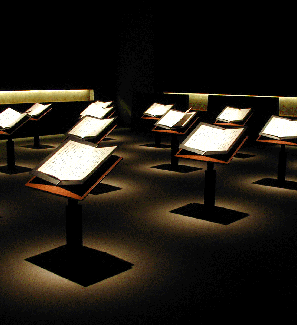
The last room of the museum displays photos and names of all the members of the Himeyuri nurses that lost their lives. This puts strong human touch to the museum as you can actually see the ones that were involved. There were also several written testimonies on display so that this part of history will be able to be preserved.  The testimonies were written in Japanese and English, so we were able to read the words of those that survived as well as some of those that did not.
The museum does have a nice garden to walk through after leaving to help you think about what you have just seen, and to appreciate how things are now in peace.  We wanted to be considerate of Kiyoko san, so we didn't stay in the garden at all.
There was a big plaque at the end of the museum, right by the stairs to go outside.  It had a statement on it by a Japanese official, I forget who it was.  But, it struck a chord with me because it was the first statement I had seen all day that admitted that the Japanese government purposely directed the inevitable battle between America and themselves onto the island of Okinawa in order to avoid fighting on mainland Japan.  The people of Okinawa were viewed as second class citizens, and therefore were expendable.  The Japanese government did not care what happened to this island or to the people who lived here.  They wanted to protect the Japanese citizens and mainland Japan from the war as best as it could. 
When we met up with Kiyoko san again, she had a treat for us.  I guess she had decided to forgive us for wanting to be places that she thought were awful and haunted.  She had bought us a package of mochi.  We have had mochi in Japan and love it, but this was a treat unique to Okinawa because the mochi was filled with a sweet potato only grown in Okinawa.  This sweet potato has a purple inside.  It is very sweet to the taste, and therefore perfect for mochi.  We all thanked her and bowed.  The mochi was excellent and we all loved it!
The time for Mimi's "birthday party" had passed, but Kiyoko san didn't mention it at all.  She wanted to help us find the apartment we were renting for the next two days.  She talked and laughed with us about the differences between Okinawa, Japan and America as she drove us to our apartment.  We had a little trouble finding it, but she helped us and made sure we got in before we hugged her good-bye.  It was bittersweet to say good-bye to her. 
Our new place was so tiny, but only one person was going to need to sleep on the floor.  There were enough beds or a couch for almost everyone.  And, it was VERY CLEAN!!!  This was a nice change from the other places we had stayed in thus far in Okinawa.  After we got the kids settled, Ray and I walked a few blocks to a grocery store and bought enough food for the remaining time that we had on this island.
We were all pretty tired, so we decided to go out for dinner.  We tried to find an Okinawan type restaurant, but everything was super expensive and we couldn't afford it for our family size.  Instead, we ended up at McDonald's.  It was still a little bit of a "cultural experience", though, because the McDonald's menu is very different from the menu in America.  One example is that you can order a hamburger that has a fried egg on top of the patty.
As we were all walking to find a restaurant, we were walking along a road that bordered an American military base.  We didn't think much about it until the evening taps/retreat were played.  Raymond and I didn't even really think about what to do, we were used to it from Ray's military days at the beginning of our marriage.  We stopped and faced the American flag blowing in the breeze and put our hand on our heart.  The kids watched us and followed suit.  We stayed like that, our large American family standing on the side of an Okinawan road, and paid tribute to our country's flag until the taps/retreat ended.

Given everything that we had seen and learned on this day regarding the Battle of Okinawa, it was refreshing for our souls to honor our flag and maybe in some small way also honor those courageous American soldiers for the hard things that they had to do on this island and all over the world during WWII.  They truly are the "greatest generation".  We know that it wasn't easy for them to invade this island like they did, but it was where the Japanese put the battle and they came in and did what they had to do.  War for everyone is gruesome and tragic.  We learned today that in the Battle of Okinawa, the real victims of that battle were the ones who were caught in the middle--the Okinawans.

Okinawa Day 6: Okinawa Prefecture Peace Memorial Museum


Today is Boys' Day!!!  For the last month or so, we have seen carp flags all over Japan.  We have also seen miniature samurai armor on display in anticipation of this day.  Because of Boys' Day, there were thousands of carp flags all over the lawn of the Peace Museum. 
There was also the largest carp flag we had ever seen being flown from a crane. 
We walked through the park and came to the entrance to the Peace Museum.  I asked Kiyoko san if she had been through the museum and she said that she went through it when she was in school. 
At the entrance, there was a plaque that read:
In late March 1945, a fierce battle such as has rarely been seen in history took place on these islands. The "Typhoon of Steel" that lasted for ninety days disfigured mountains, destroyed much of the cultural legacy, and claimed the precious lives of upward of 200,000 people. The Battle of Okinawa was the only ground fighting fought on Japanese soil and was also the largest-scale campaign of the Asia-Pacific War. Even countless Okinawan civilians were fully mobilized.
A significant aspect of the Battle of Okinawa was the great loss of civilian life. At more than 100,000 civilian losses far outnumbered the military death toll. Some were blown apart by shells, some finding themselves in a hopeless situation were driven to suicide, some died of starvation, some succumbed to malaria, while other fell victim to the retreating Japanese troops. Under the most desperate and unimaginable circumstances, Okinawans directly experienced the absurdity of war and atrocities it inevitably brings about.
This war experience is at the very core of what is popularly called the "Okinawan Heart," a resilient yet strong attitude to life that Okinawan people developed as they struggled against the pressures of many years of U. S. military control.
The "Okinawan Heart" is a human response that respects personal dignity above all else, rejects any acts related to war, and truly cherishes culture, which is a supreme expression of humanity. In order that we may mourn for those who perished during the war, pass on to future generations the historic lessons of the Battle of Okinawa, convey our message to the peoples of the world and thereby established, displaying the whole range of the individual war experiences of the people in this prefecture, the Okinawa Prefectural Peace Memorial Museum.

We went inside and hit the gift shop first.  I wanted to purchase a book on the Battle of Okinawa.  Each of the kids also got a pair of shisa dogs. 
Kiyoko san refused to go through the museum with us and seemed upset that we were going to go.  She didn't want Mimi to come with us, either.  We told her that we would be a few hours, and we would meet her outside in the park area.  We tried to explain to her that we wanted to teach our children about her island's history, but she was upset and didn't want to hear our reasons for going through the museum.
At the desk where we paid to go in, there was a glass floor showing some shells that had been discovered during the building of this museum.  They left the bombs exactly where they were discovered and built the glass floor so that they could be displayed.
It was pretty awesome to see.  It was a reminder that what we were about to see was real.  Sometimes when you just see pictures of a war, it almost seems unreal and far removed from your reality.  Seeing these shells brought the battle into a reality that was sobering.
Once we entered the actual museum, we were forbidden from taking pictures.  The following pictures of the museum are from the museum's official website. 

In Room 1, titled "Road to the Battle of Okinawa", we read about the events leading up to the Typhoon of Steel.  During the Meiji period, the Japanese government took over the Ryukyu Kingdom.  Up to this point, the islanders had been a very peaceful people and were not prepared to go to war against Japan.  They became a part of Japan and the government worked rapidly to assimilate the native islanders to the ways of the Japanese.  In the schools, the children were taught the Japanese language and it became forbidden to speak any other language.  They also tried to force their Buddhist religion on the people, but that never really happened like they would have liked.  Many parts of the culture of the Ryukyu Kingdom were lost as Japan forced the islanders to assimilate and be faithful subjects of the Japanese emperor.  (Today, Okinawa still has a king and a queen, but Okinawa is subject to the Japanese government and the emperor.)
At this time, within Japan there was a great rush for modernization.  Remember, Emperor Meiji was the one who opened Japan up once again to the world after centuries of being isolated.  They were stunned at the technology that other countries had, such as guns and cannons, and they were in a hurry to bring the Japanese empire up to speed.  A policy and mindset was adopted to "enrich the country with a strong army" so that Japan could invade its neighboring countries.  The national war effort escalated into the Manchurian Incident, the Shina-Japanese War and the Asia-Pacific War, in which Okinawa became the last battle ground of the so-called "15-Year War" that started in 1931.

As we were making our way through this room, Mimi showed up all by herself.  We didn't know what was going on, but kept her with us for a few minutes.  However, after a few minutes, she wanted to go back to her grandma, so Raymond took her out and found Kiyoko san. 
Room 2, The Progress of the Battle:  Here we watched a short movie that described the Battle of Okinawa from the Okinawan people's perspective.  We also studied really cool 3-D maps that outlined the destruction caused by the battle.  The maps were able to show how the battle changed the island's landscape.  There were also items of wartime objects, such as medicinal items, canteens, and some uniforms. 
The Japanese Army and the U.S. forces threw all their might into the Battle of Okinawa, creating the bloodiest battle of the entire World War II.  The U.S. forces indiscriminately bombed the central and southern parts of the island from the air and the sea.  This "Typhoon of Steel" lasted about 3 months, claiming the lives of more than 200,000 civilians and soldiers.
As we walked from Room 2 to Room 3, we passed an entire wall made of carnage from the battlefield.  Caged within wire, we passed a wall formed from boots, Kevlar helmets, canteens, belts, and other items left behind by both the Japanese and the American soldiers. 

Room 3, Battleground of Hell, was a gut-wrenching room to go through.  This is where most of us cried. 
There were large pictures showing the atrocities with which the Okinawan people were forced to endure during the battle.  We saw pictures of children who were naked, starving, and had wounds from the battle staring back at us with haunting eyes.  Another picture showed a woman trying to cook rice over an open fire with complete destruction all around her.

I did find this picture on the internet, and this was one of the pictures found in this part of the museum.  Wrenches at your heart.
When the Japanese troops were cornered at the southern tip of the island and were wiped out, the area turned into an inferno where the islanders and troops fled from one cave to another in a desperate scramble for their lives.  In some caves, Japanese soldiers slaughtered Okinawans or else forced them to commit mass suicide.  Some residents died of starvation.  In this room, they had built "caves,"  each one showing a different scene of some of the things that happened in the caves during the 3 month battle period.  Some were used as "hospitals" for the Japanese soldiers, another "cave" showed an Okinawan family huddled in sheer terror.  Outside of these caves, hell broke out as artillery fire, mortar shells and flame throwers killed Japanese troops and Okinawans in mass numbers.
This was the hardest room to go through in the entire museum. 

Room 4, Personal Testimonies: In this room were written personal testimonies of what actually happened to the civilian victims during the battle.  There were people who by some miracle survived the Battle of Okinawa, and gradually over time they were able to record their experiences so that their testimonies may be passed onto future generations.  These testimonies speak the very truth of history.  All of the testimonies were written in Japanese, so unfortunately, we were not able to read them.  In the back of this room, however, there were booths where we could listen to some personal testimonies in English.  We crowded into a booth and listened to a few personal stories.  It was sad yet fascinating to listen to the stories of the horrors that the Okinawan people endured. 

Room 5, Okinawa--Keystone of the Pacific: This room showed life on the island in the postwar refugee camps, the 27 year military occupation by the U.S., and Okinawa's struggle for independence and peace.  The refugee camps began in 1945.  A few years later, as Cold War tensions rose between the U.S. and the Soviet Union, Okinawa was turned into a military base complex.  Land was confiscated to build the bases.  The resentment by the Okinawans were found in the island-wide movement for reversion.  Even now, with the Cold War ended, regional or ethnic violence continue to occur in many parts of the world.  Because of this, the United States is not leaving Okinawa any time soon.  This reminded us of what we had seen on the island thus far during our stay here.  Many Okinawans want the U.S. military to leave the island.  Others say that without the U.S. military the island's economy would be much more dire than it already is. 

The museum stated that it hopes the lessons learned from the Battle of Okinawa will be dispatched to every corner of the world and create peace.
After we left Room 5, we took an elevator up to an observatory.  We got a 360 degree view of the museum's Peace Park, the beach where the U.S. forces landed, and the surrounding area.  We thought about the battle that took place here both on land and the sea.  We thought about the sheer destruction and the thousands upon thousands of lives that were lost on the land that we could view from this observatory deck. 
We had been in the museum for almost 3 hours.  We found Kiyoko san and Mimi at the end of the museum.  She seemed to be in a better mood.  We then headed outside to explore the Peace Park.


The museum is massive!  We didn't realize how big of a building it was while we were going through it.  The park is huge as well.  We could spend an entire day just exploring this park and all of the memorials.  The park is on the top of what is known as Mabuni Hill, which is where the Battle of Okinawa came to a bitter end and where the most bloodshed took place.
The large stone plaque for the Cornerstone of Peace.
Reminiscent of the Vietnam War Memorial in Washington D.C., there were walls containing the names of those who died during the Battle of Okinawa.
They were in alphabetical order and organized by country.
We spent a little bit of  time wandering around the walls of names.
Chris noticed this flag next to an American wall, but it was laying on the ground.  I watched him as he reverently bent over and set it up so that it wouldn't fall over again.  A few minutes later, I noticed both Logan and Christopher walking around picking up American flags and pushing them into the ground a little bit so that they would stay upright. 
 
 This is the Flame of Peace. (It wasn't going today for some reason.  Usually there is a flame at the top of the cone.)  It is surrounded by a shallow circular pond.  The flame is fed by flames from both Hiroshima and Nagasaki as well as a flame from Zamami, where U.S. forces first landed on Okinawa in 1945. This flame is where visiting heads of state come to pay their respects to the dead.
The family by the pond and the Flame of Peace.
This is a picture of the U.S. forces landing on the beach of Okinawa during WWII.
This is the view (looking left) of the very same beach that we saw from the overview deck near the Flame of Peace. 
Looking right.
Most of the family standing at the historic beach.
There was a trail that one could go down and walk along the sand of the beach, as well as many more smaller memorials to see.  However, Kiyoko san was anxious and didn't want to be at the park at all.  She told us that she had to get Mimi to a birthday party at 4 p.m., so we had to move on.  I knew that she wasn't telling the truth, but it was past lunchtime and we had been on our feet all day.  The kids were hungry and tired.  Physically, they were tired from our morning hike along the cave trail and standing for almost three hours in the museum.  Emotionally, they were spent from seeing and learning about the bloodiest battle of WWII.  I wanted to spend a lot more time here, but the family's empty stomachs and Kiyoko san's need to leave this "haunted area" won out.  We began to walk back to the van.  (I do regret not putting my foot down and insisting that we spend more time here.  Though it will probably never happen, I hope to have the privilege of someday returning to this park and spending the appropriate time exploring all that there is to see.  It would take the better part of an entire day.)
We passed more walls of names as we made our way to the parking lot.
We also passed a few more monuments.  At this park, there are over 50 memorials or monuments from other prefectures or organizations dedicated to the memory of those lives lost during the 90 day battle.
This is a sign for another one, which is below.
I thought this memorial was very beautiful.  It's very Japanese looking.
We paused to take a picture with the throngs of carp flags hung in honor of Boys' Day.  In the background, you can see a tall white tower.  This is the Okinawa Peace Hall, which houses a 12 meter high statue dedicated to world peace.

Another view of the thousands of carp flags as we headed to the parking lot.
I was irritated with Kiyoko san at this point of our day.  Given the places we were going today, I could sympathize that they might be emotionally uncomfortable for her to visit.  However, Ray and I firmly believe that we need to teach our children the lessons of the past so that they can do whatever is in their power to create a better future.  We felt like visiting the places that teach us about the history of the Battle of Okinawa were the very top places to see on this island out of all of the many places to choose from.  It was a miracle and huge blessing that our family was on this island and I wanted to take the opportunity that we had to learn all that we could during our short time here.  I didn't appreciate Kiyoko san trying to make up a story to move us along and miss out on everything that there was to see and learn. 
After we grabbed some lunch, we told her our last place to see today: the Himeyuri Museum.  She was not happy about it.  Another WWII place.  We told her that we wanted to teach the kids about the Battle of Okinawa and her island's history.  She begrudgingly drove us to our next stop.